
Vol. 2, Issue 1: "Predtech" - 2026's Word of the Year
I'm calling it now.

Hey everyone,
Soooo...
Remember when I wrote, “I don’t know when I’m going to be back with Volume 2: it could be in two months, or it could be next week, lol.”?
Well...
Maybe I should stop trying to predict my writing schedule and just... you know... write.
Which I did. And it’s a doozy.
Please enjoy a brief update on Fictive Kin Equity Lab before buckling up for the ride.
Lab Notes
Impolite Society: A Romance & Revolutionary Practice Learning Guild is running full steam ahead!
Our romance and revolutionary practice theme for the rest of this month is Love Beyond Softness: Love is a political force, not a passive one. Let’s examine how it can fuel justice, boundaries, and refusal to accept things as they are.
We are doing this examination by reading and discussing The Takedown, by Lily Chu, where love does, indeed, conquer all...
Up to and including a gleefully unscrupulous designer and the quietly inequitable multimillion-dollar corporation they work for.
Click here to learn more, and to register!
Towards a (Messy) Definition of Predatory Technology
First, I know that “Words of the Year” are announced by, like, official dictionary... officials, after the year in question has passed. But since I have already deemed 2026 to be the Year of the Traitor (in which we all commit to betraying the betrayal economy), I figure that I can now claim lexical rights as well.
That being said, adequately defining “predtech” is going to be messy.
I’m still thinking through how to connect the dots between what “predtech” means and how it shows up because, quite frankly, the scale of it is so enormous, so all-encompassing, it’s almost - almost - impossible to perceive.
I can say, however, that it all started the other day, when I was closing a tab on DuckDuckGo, and I noticed the little number count thingy they have in the top left corner of the search bar.
You know, the number that lets you know how many web trackers they’ve blocked for you in the last seven days. (FYI, that day, it was 249.)
This was not the first time I’d noticed the number but, for whatever reason, it was the first time I’d really paid attention to it and what it signified.
Maybe it was because a few days before that, more Epstein files had been released. More names had been mentioned. That is, more predators’ names had been mentioned.
Whatever the reason, I started thinking more about everything that enabled, and continues to enable, these men. From there, me and my neurodivergent brain made the leap from “web tracker” to “human stalker” to “sexual predator”.
Because web trackers do the same thing that human predators do: remain invisible, or even hidden in plain sight, while they track your every move, your every expression, your every routine.
They record what you do, where you go, who you meet, what you say, how you say it... All for the purpose of building a profile on you, which they then put to use with manipulative, coercive, intent.
That is, with the intent to “feed” us things that make us feel so good, we never stop to think about how they know what those things are in the first place.
The tracker / predator says, “Sure, I’m following you. Sure, I’m watching you. Sure, you could say I’m stalking you. But look... Look at how good I’m making you feel! Look at how much you like it! Look at how much you want it... Look at how much you’ve started to crave it.”1
There are innumerable systems that enable this type of grooming behaviour. They include economics (of course), law, governance, business, physical and mental health, education, and most significantly, technology.
“X”-tech
I’ve had a lot of “job lives”, so to speak. I’m still coming to terms with the fact that this is very typical (heh) of neuroatypical people.
Between our sensory and environmental sensitivities; our need for highly complex cognitive and intellectual stimulation; our pattern recognition / intuition; and our disdain for busywork, micromanaging, and bullshit hierarchies that don’t make any sense, well... we move around a lot (if the opportunities to so do present themselves, that is).
Several years ago, one of the career moves I made was into the technology and innovation space. It was my first time working in that sector, so the learning curve was steep... and I loved every minute of it. (Neurodivergent / gifted brain, remember?)
My role was “tech-adjacent”, but I was close enough to it that I basically had a front-row seat to numerous conversations about what technology was for; how it could and should be used for good; and just how profound its overall impact was on every aspect of society.
I also became fairly well-versed in the vocabulary used to describe the various types and purposes of technology, dependent on the sector. Given that my brain never stops “brain-ing”, then, it’s no wonder that it quickly made the leap from predator to technology to arrive at predtech.
As I posted in my Substack Note2 a few days ago:
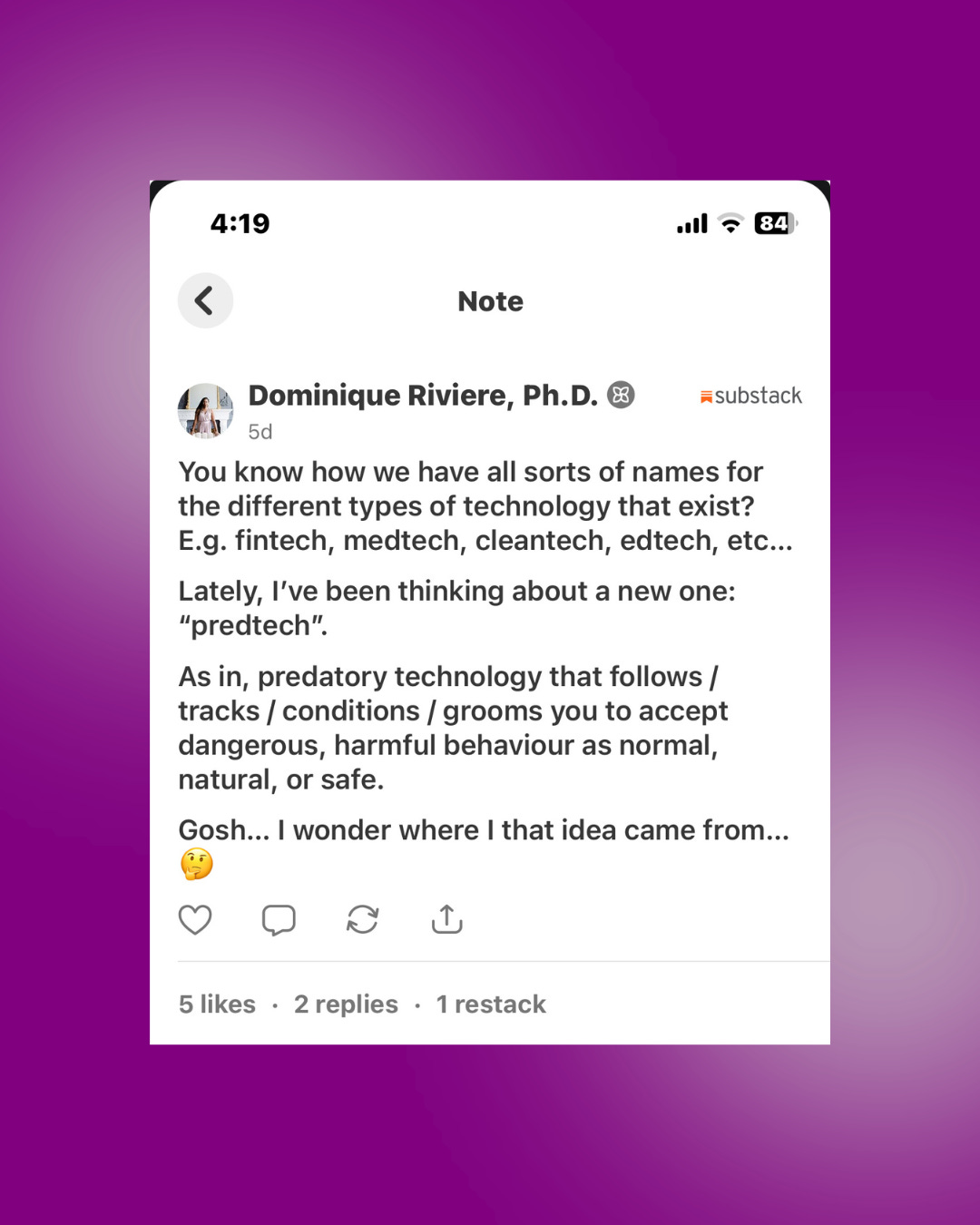
“Normal, natural, and safe?” Yeah… I don’t think so.
You may have noticed that I have a Ph.D.
It’s been nearly twenty (!!!) years since I got it, which means that I am not as well-versed in my field as I once was. That being said, there are some concepts that were so mind-blowing to me at the time, they inform how I understand the world to this very day.
One of those concepts was cultural hegemony. I’m not going to get into its full definition and all the intricacies and nuances therein (mostly because I don’t remember them, lol).
I’m just going to say three things:
1. It is a concept that was first developed by Antonio Gramsci3 to describe the ways in which the dominant4 class wins our consent to participate in our own oppression.
2. Through the lens of our current political moment, I can see that the tactics used by the dominant class to achieve this are distinctly predatory.
3. The thing that enables those tactics is a particular narrative. That is, a particular story - about who is worthy and who is not; who is remarkable and who is disposable; who is deserving, and who constantly needs to prove their right to even exist - that has been imbued with so much institutional power and emotional resonance, over thousands of years, that it has come to feel “true”. Normal. Natural. And even safe.
(Yes, patriarchy.5 I’m talking about you.)
This narrative permeates all aspects of our society, including technology.
Especially technology designed by men who were a) already dominant / predatory, and who wanted to maintain their position, by any means necessary; or b) “pick me”s who so desperately, desperately wanted to become dominant / predatory themselves, all because they believed they were entitled to that position.
Confession.
I don’t actually know what to do about all this.
It’s not so simple as saying, “Well, if you we don’t like the predtech, then don’t use it”, because the thing about predtech is that you can’t always tell what it is and what isn’t.
Not really.
And even if you could, at this point, we’re all so habituated to it that just to say, “stop using it” is equivalent to saying, “Well, if a woman didn’t want to be sexually harassed or assaulted, then she shouldn’t have been wearing what she was wearing.”
Ummmm... NO.
Just like the onus is on the harasser or assaulter to, you know, not sexually harass or assault anybody, the onus is on the creators, developers, and funders of technology to not groom us for their own predatory purposes.
But, of course, they’re not doing that.
And I don’t have an answer for how to get them to start.
That being said... I do have an idea.
The idea is that there is always power in naming things as they are. In pulling back the curtain, ripping apart the veil, and exposing the rot at our society’s core:
“The [Epstein] files didn’t reveal something new. They stripped the last layer of deniability from something that has been running in plain sight — in every countdown timer, in every shame-based email sequence, in every authority-manufacturing exercise, in every room where powerful men decided what women were for and built systems accordingly.
Then Dr. Riviere dropped the word. And I — the jaded woman, the woman who has spent a decade inside this analysis and no longer expected to be surprised by any of it — went still.
We are not at the end of this reckoning. We are barely at the beginning.
And now we have the name.” ~ Kelly Diels, “There’s a word for why you hate marketing…” 6(emphasis added)
This is why I want our engagement with the concept of predtech to be collective.
I want you to give me your examples. I want you to show me your analyses.
I want you to help me generate a community-based, whole-chested, unapologetically rigorous understanding of what it is.
Where it shows up.
How it operates.
Give me your specifics, your details, your own messy thinking on this.
This is how we start connecting the dots between predtech and empire.
Let’s fucking go.
If you’re thinking that there’s such an obvious thread of sexualized violence under all of this, well... So am I.
I’m going to write a Part 2 for this post, where I can address this in more details. Stay tuned.
Edited to add: Part 2 has been written! Check it out below.
I want - nay, need - you all to know that this here little ol’ social media post of mine inspired a blistering, blazing epistle of righteousness from business coach, cultural theorist, and feminist marketing educator Kelly Diels, whose work I have admired and followed for years.
Moreover, it was specifically her writing on the predatory tactics that are embedded in conventional marketing practices that helped me to come up with “predtech” in the first place. I tried to find a quote from her piece to highlight in this post, but there wasn’t a single one that could do it justice. The whole thing needs to be read in its entirety, which you can do here.
An Italian Marxist and public intellectual who developed the concept while imprisoned under Benito Mussolini's dictatorial regime.
Who, from now on, should be referred to as the “predator class”. h/t Phil BeLight -

Celeste Davis, Matriarchal Blessing. There is one word that explains how so many men can be in the Epstein files. So why is no one saying it?
Oh look... I did manage to find a singular quote from Kelly Diels’ piece after all!
Here's my contribution: I think one of the elements of predtech is the socioemotional operating system built into our online buying systems AND that gets installed in all of us -- yes, cultural hegemony (LOVE ME SOME GRAMSCI!!), writ large -- AND on a more micro-behavioural level, the mental triggers that activate behaviour below the level of consciousness. In the field of persuasion, there are 8: Reciprocity, Authority, Social Proof, Belonging, Authority, Liking, Consistency, Belonging. These 'triggers' get overlaid on top of things that might actually be neutral, in order to create soft coercion. I'm not explaining well but I'm trying to say that these triggers, when used in combination with power inequities and status inequities and information asymmetry and high stakes situations, turn something into predtech. The high stakes /low stakes thing is important, because these triggers also have social benefit and personal utility. If we had to research every item on our grocery list, for example, it would take six weeks to complete a quick grocery trip. But if we use Social Proof to make quick decisions about what yogurt or toothpaste to buy, we save time and cognitive labour. Those are low-stakes because the risk is $5 for yogurt. It's not life altering. So the triggers can have positive outcomes and actual utility, unless they are deployed in high stakes situations where one party has a lot to lose and does not have access to all the information (or status) that the person initiating the interaction does.